Missing a tooth can throw off more than just your smile. It can affect how you chew, how you speak, and even how your other teeth hold up over time. If you’re exploring your options, you’ve probably heard about dental bridges and dental implants. Both can fill that gap. But they work very differently. And one might be a much better fit for your situation than the other.
Let’s break down what each option actually is, along with the pros and cons, so you can have a clearer picture before talking with your dentist.
What Is a Dental Bridge?
A bridge does exactly what its name suggests. It bridges the gap created by one or more missing teeth.
The teeth on either side of the gap are prepared by removing a small amount of enamel. Those teeth become the anchors. Then a custom-made prosthetic tooth (or teeth) is attached to crowns that sit over those anchor teeth. The new tooth sits in the middle, filling the space.
Bridges are a traditional solution, and they’ve helped countless patients restore their smiles.
Pros of a bridge:
- Treatment is usually completed in just a few weeks
- No surgery is required
- Often lower upfront cost than implants
- Works well when the adjacent teeth already need crowns
Cons of a bridge:
- Requires shaving down healthy adjacent teeth, which can’t be reversed
- Does not replace the missing tooth root, so the jawbone beneath the gap can weaken over time
- Typically lasts 10 to 15 years, then needs replacement
- Can be harder to clean around, increasing the risk of decay on the anchor teeth
What Is a Dental Implant?
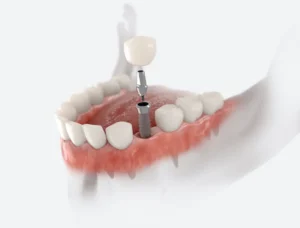
An implant is a small titanium post that is surgically placed into your jawbone. That post acts as an artificial tooth root. Over a few months, it fuses with the bone in a process called osseointegration. Once that bond is solid, we attach a custom crown on top.
The result is often a tooth that feels, functions, and looks just like a natural one.
Pros of an implant:
- Preserves and stimulates the jawbone, preventing bone loss
- Does not affect or rely on adjacent healthy teeth
- Can last a lifetime with proper care
- Feels completely natural and stable
- Easy to clean, just like your natural teeth
Cons of an implant:
- Requires a minor surgical procedure
- Treatment takes several months from start to finish
- Higher upfront cost than a bridge
- Requires enough healthy bone to support the post
So Which One Should You Choose?
There’s no single right answer for everyone. It depends on your specific situation.
An implant is often the preferred choice for a single missing tooth, especially if the teeth on either side are perfectly healthy. It preserves bone, doesn’t require touching good teeth, and lasts a very long time. It also gives you the most natural feel and function.
A bridge can be a great option when the adjacent teeth already need crowns for other reasons. It’s also a good choice for patients who are not good candidates for surgery or who prefer a faster, simpler approach.
What About Cost?
It’s true that a bridge usually costs less upfront. But that bridge will likely need to be replaced in 10 to 15 years. An implant, on the other hand, is designed to be a long-term investment. When you factor in replacement costs over a lifetime, implants can actually be more cost-effective in the long run.
Many insurance plans cover a portion of both options. We can help you understand your benefits and make a financially sound choice.
Let’s Find Your Best Option
The best way to know which choice is right for you is to get a professional evaluation. We will take a look at your smile, your bone health, your overall dental condition, and your goals. Then we’ll lay out both paths clearly so you can decide with confidence.
Have questions? Ready to explore your options? Call our Ardmore office at (610) 839-8967 or request an appointment online. We’ll help you figure out what’s best for your smile.